|
|
CONCERT REVIEW
November 30, 2005
by Timothy Hanson
Last night the Mexican-American Symphony Orchestra had its debut concert at Town Hall as the swan song of the Mexico Now festival, a series of concerts, screenings, and performances showcasing the cultural vibrancy of contemporary Mexican artists. The newly formed orchestra presented an all-Mexican program of 20th-century works: Danzón 2 by Arturo Márquez, Clepsydra by renowned contemporary composer Mario Lavista, the U.S. premiere of Enrico Chapela’s soccer-inspired symphonic poem Íngesu, Silvestre Revueltas’ masterpiece Sensemayá, and the world-premiere of La Promesa Del Guerrero for Violin, Tenor, and orchestra by Ernesto Villa-Lobos.
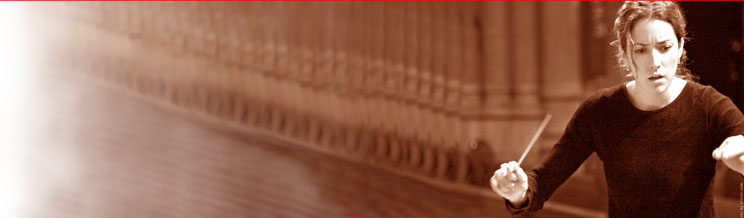
The orchestra’s music director and conductor, the very young and very talented Alondra de la Parra, led passionately and confidently. Her youthful appearance belies a facility that only the most musically mature can claim. Her presence, at once commanding and comforting, made it easy for orchestra and audience both to invest their full attention for the duration of the concert. The program she chose did not distract or disappoint either. The Marquez Danzon 2 was fierce and lyrical by turns, albeit a bit repetitive for my taste. Clepsydra, by Mario Lavista (who’s music was a happy discovery for me last night), inhabited the dreamy world of gesture that only music can convey. The textures were delicate and the colors kaleidoscopic and Ms. de la Parra and the orchestra painted the picture exquisitely.
By far the most entertaining piece of the night (in the theatrical sense) was Enrico Chapela’s Ínguesu, which translates roughly as “drats!” The orchestra donned soccer jerseys, and Ms. de la Parra emerged from the wings clad as a referee, whistle and all. The piece re-enacts, play by play (in hyper-condensed time) and complete with a well-timed and artfully projected scoreboard behind the orchestra, the 1999 FIFA Confederation Cup match between Brazil and Mexico, the woodwinds representing Mexico and the brass representing Brazil. The strings were the crowd, which in a Mexican soccer stadium are rather vocal about their opinions. Chapela’s themes were taken from the various chants and jeers one would hear at a soccer match, all of which are very familiar to Mexicans and none of which are extraordinarily polite. It was a delight to see the audience alert to these moments of familiarity. Despite all the antics, or rather in addition to them, the piece was well crafted, energetic, and captivating. Mr. Chapela said, “I just want people to have as much fun listening to the music as I have imagining it. Classical music is too caught up in being ‘serious.’ But you don’t work music, you play it!”
The second half of the program featured the world premiere of La Promesa Del Guerrero for Violin, Tenor, and orchestra by the young Ernesto Villa-Lobos (who also played the solo violin part). This work was inspired by the legend of the two volcanoes, the Popocatépetl and Iztaccíhuatl in Mexico City, which is the story of a warrior and his love. As Mr. Villa-Lobos’ first orchestral composition, the work was very ambitious. Villa-Lobos handled the orchestra with finesse with perhaps a slight tendency to overly rely on the string section. Parts of the orchestration enveloped the soloists, which was effective when it seemed intentional but otherwise it was disappointing. All in all there were too many ideas in the piece. This is a typical problem for most composers, so the young Mr. Villa-Lobos should not worry too much about that. Where he does have an advantage is in the quality of his ideas. They were all engaging and expressive and very imaginative. He exhibited a wide range of stylistic capacity, from tense and dissonant to lyrical to rhapsodic and finally heroic. His performance on the violin was downright awesome. He demonstrated a thorough knowledge of his instrument and masterful execution. Tenor Mauricio O’Reilly sang boldly and dramatically.
The concert came to a close with a performance by the late Silvestre Revueltas, often considered Mexico’s greatest composer. The orchestra fulfilled its promise by playing with fire and conviction through the very last note. Ms. de la Parra and the musicians all received a well-earned ovation.
“The orchestra really should be an open forum for experimentation,” says Ms. de la Parra. “The question I’m constantly asking myself is how we can create something more representative of the diversity of contemporary life. How can we utilize the established foundations of the past and augment them with new ideas to keep the orchestra evolving so it doesn’t grow static?” If concerts like last night’s are any indication of how Ms. de la Parra and the orchestra are approaching those questions, then the symphony goers may rest assured that the future holds many exciting surprises for them.
The orchestra consists of mostly young people and, true to its name, is largely made up of Mexican and Latin American musicians, although by no means exclusively. “I really like the idea of a younger orchestra,” says de la Parra. “It gives us the opportunity to reach out to an audience that is sorely neglected by classical music. And that’s the problem. If you don’t reach out to young people it’s only a matter of time before you’re without an audience.” Reaching out to atypical classical audiences is one of the main objectives of this orchestra. In addition to making an appeal to young people, the orchestra, as its name suggests, is particularly interested in making this music approachable to the Mexican and Latin American population of New York City, a very large population indeed. “We’re not trying to make something that is solely about Mexican art and culture. This is really about cultural exchange. Exchange between the United States and Mexico and Latin America, exchange between the past and the present, exchange between uptown and downtown.”
The Mexican-American Symphony Orchestra is looking for a permanent home. “I would like to the orchestra to be based in the Upper West Side,” says de la Parra. “Not just as a matter of convenience. Many of the musicians in the orchestra make their home here, myself included. It’s not a fluke. This area is everything a musician needs. We can perfectly balance our need for quiet and activity, solitude and community. The people in this area run the gamut from students to families to retirees, artists, workers… it’s just so representative of the diversity the orchestra seeks to showcase.” More information can be found at www.masorch.org.
|
|